For more than three decades, the annual Alumni Beef and Oyster Roast at Boys’ Latin School of Maryland followed a familiar rhythm. Alumni, parents, faculty, and friends gathered to reconnect and support the school. What they had never done in those thirty-plus years was hire live entertainment.
That changed the night PaintJam walked in with canvases, music cues, and a plan that felt like a calculated risk for everyone involved.
The school’s contact understood the hesitation. Budgets were tight. Expectations were conservative. But there was also a sense that the event had plateaued, and that it was time to try something different. The solution was a partnership rather than a standard booking. PaintJam would deliver a full three-painting show.
It was a new model for the school and a familiar kind of experiment for PaintJam.

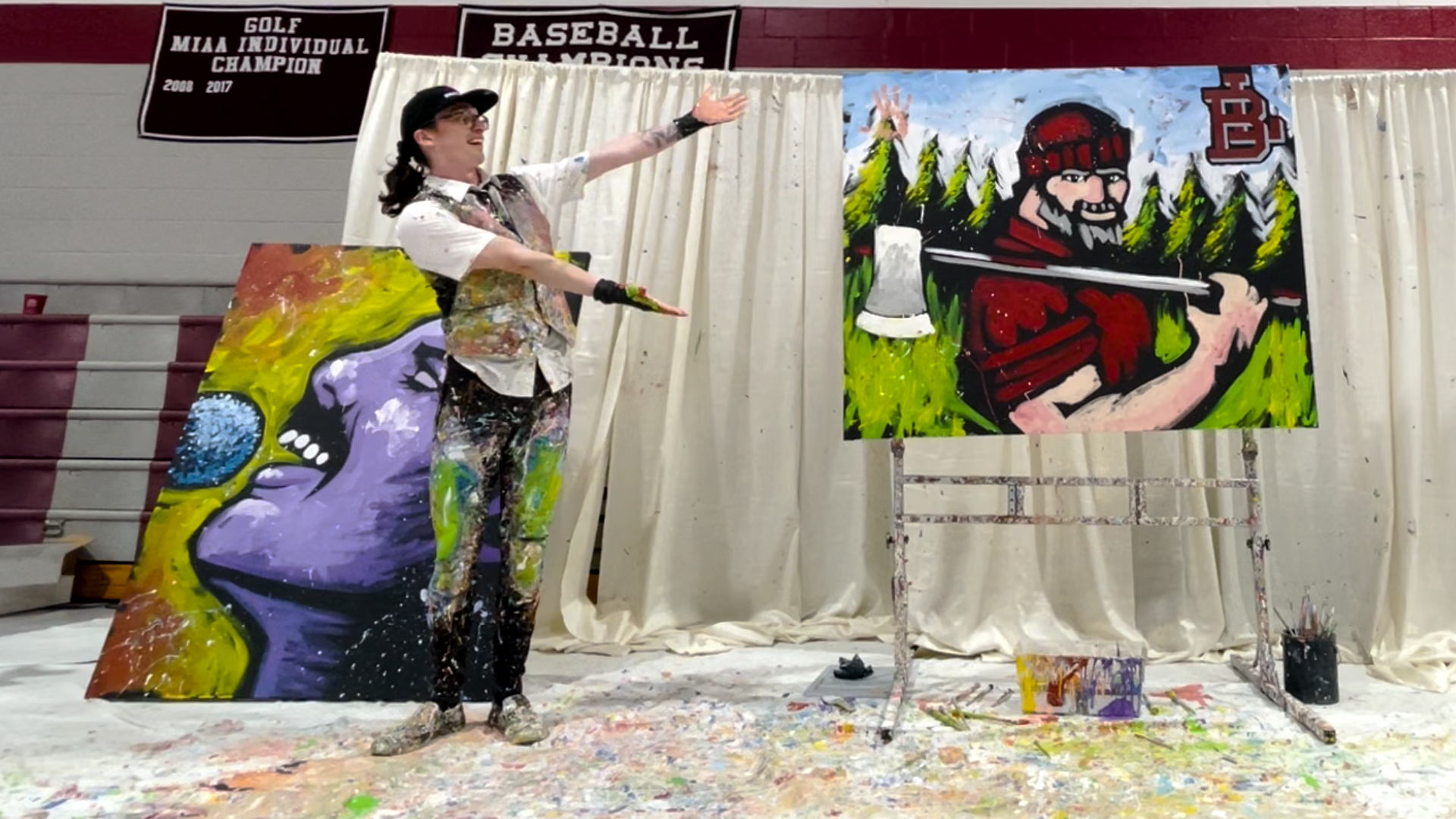
The show opened with a portrait of Freddie Mercury. Not a safe choice. Not background-friendly. But that was the point. From the first notes of We Will Rock You rolling into Don’t Stop Me Now, the performance leaned into Freddie’s energy rather than treating him as a static portrait. Painting live, especially at speed, is one thing. Performing one of the most recognizable showmen in music history is another.

The show closed with Larry the Laker, the school mascot designed by an alumnus. Larry is a Paul Bunyan–style character, a lumberjack holding an axe. Harvey chose to give Larry a bit of a Paintjam flair. He placed Larry in a forest, grounded him in a landscape, and gave him warmth and dimension.
It was a choice that carried some risk. Reinterpreting a mascot can go sideways fast. What made the moment land was what happened afterward.

During the meet-and-greet, Harvey met the retired teacher who had originally designed the Larry the Laker logo. Rather than bristling at the reinterpretation, he was delighted. He noticed the trees. The background. The way the character felt alive rather than symbolic. That conversation led to a commissioned piece on the spot. The only note the teacher had was about splatter. “Too much,” he said. Harvey countered, half-joking, “Splatter is my style. I make a mess.” They compromised. Light splatter for the commission.
After the show the pieces were auctioned off. People were excited. They talked about the show afterward. Richard made a point of saying how proud he was that the school had finally brought in entertainment and how strongly it was received.
The audience that night spanned generations. Current parents stood next to alumni who had graduated decades earlier. Grandparents filled the room. There were few children present, but the work still landed across age groups. That is one of the quiet strengths of PaintJam’s format. It is visually immediate without being juvenile, energetic without being chaotic.

After the final brushstroke, Harvey stayed. He talked with attendees, answered questions, took photos, and listened to stories about the school. That time on the floor often matters as much as the performance itself. It turns a show into a shared experience rather than a transaction.
For Boys’ Latin School, the night marked a shift. A tradition expanded without losing its roots. For PaintJam, it was another reminder that some of the most meaningful performances happen when a client is willing to try something they have never done before.